Showing posts with label review. Show all posts

Monday, April 01, 2013

Book review: Murder on Ice

Backwoods Canada, depths of January, and the townspeople of Murphy's Harbour are getting ready for their Winter Carnival. One of the events is a beauty pageant, which turns sour when the out-of-town winner is snatched by kidnappers, just as she is about to receive her crown.

At first it looks as if it's a publicity stunt by a Women's Liberation group, but when local cop Reid Bennett and his police dog Sam find the strangled body of one of the feminists in a nearby motel it's obvious there's more to the crime than first suspected.

Bennett sets off to rescue the snatched beauty queen but his efforts are hampered by the interference of other group members, who seem not to understand that their scheme has been hijacked by vicious thugs with a murderous agenda of their own.

Corpses turn up in unlikely places and Bennett battles both the killers and the weather in his efforts to bring all the gang to justice.

It has to be remembered that the book was written in 1984, so some of its attitudes need to be forgiven. The world has matured since then. Much of the phraseology about feminism and homosexuality can be explained as being correct for the characters, but the book also gives the impression that author Ted Wood might have had a few issues of his own.


Murder on Ice, Ted Wood, 1984.

Monday, May 14, 2012

Book review: The Time Traveller's Wife

Henry DeTamble is a man out of time. Cursed with a gene that gives him only a loose grip on the present, he slips in and out of the past and future, always arriving naked and not knowing when or where he is.

And that is how he meets six-year-old Clare Abshire, a very young version of the woman he knows he will eventually marry: has already married in her future and his past.

The Time Traveller's Wife is literally a timeless love story. Henry and Clare  are destined to be together, but as the book progresses it becomes clear that there can be no 'happy ever after' for their relationship. It is a beautiful tale, told with skill, from Clare's first fascination with finding a naked old man in her meadow, to 28-year-old Henry's confusion on meeting a captivating young woman who seems to know all about him.

He has time-travelled all his life and is used to the unusual, having spent much of his childhood with his older self, visiting museums and galleries, but he is lost in the face of Clare's assured approach to their first date, because he is besotted with her from the start.

I'm probably one of the last people in the world to read this book. I have been meaning to for some time and finally fell into it after finding it on this year's World Book Night list. It is a beautiful story and I read most of the last third in one sitting, because I found it almost impossible to leave the company of Henry and Clare once I met them. A week since I finished reading, I still miss them. I have not felt like that about a fictional character for a long time.

If you are one of the few people left who do not know this book, I beg you to find a copy immediately and fill that gap in your life.

The Time Traveller's Wife, Audrey Niffenegger. 2004. Vintage

Wednesday, May 09, 2012

Book review: The Bone Fire by Christine Barber

Across New Mexico they mark the Day of the Dead by burning effigies that are supposed to carry away sins and cares. In the clean-up on the morning after one such festival in Santa Fe, a child’s skull is discovered among the ashes. Local gossips are quick to assume that it is the remains of a young girl who disappeared the previous year. A murder investigation is launched, and there is no shortage of suspects among the girl’s dysfunctional extended family.


Detective Sergeant Gil Montoya is forced to sort his way through the confusion of evidence, and his hunt becomes harder when more bones start to appear among offerings on altars at churches around the town. Reporter Lucy Newroe finds herself embroiled in the investigation because of a previous connection with DS Montoya, and her part-time role as a volunteer with the emergency services.

The Bone Fire is a well constructed story about the search for a potential psychopathic killer and I guarantee that you won’t predict the final outcome. It is Christine Barber’s second novel. I’m now planning to read her first, and hope she produces many more.

The Bone Fire Christine Barber 2010 Minotaur Books (Thomas Dunne) e-edition

Tuesday, May 08, 2012

High days and holidays: a chance to read

Hello all. I've not been posting much on here lately, and the absence of the G-Man (Get well soon Galen!) means I'm not even forcing myself to write my 55 words for a Friday.  (Though I'm doing my best to keep going with the Thursday extracts.) On the other hand, it means I'm catching up on my reading, and somehow I seem to have found a run of pretty good tales to absorb me.

The recent holiday helped, which coincided with World Book Day and my sad encounter with Bill Bryson. I had time and opportunity to read because I didn't have to go to work, and the fact that the book was free gave me a motive.  I'd taken a few novels with me on my e-reader (I always do take several books on holiday) so I had plenty of supply too.

And I spent Bank Holiday Monday morning in bed, completing the final hundred or so pages of my latest choice.

So you'll be reading my reviews over the next few days, because I'm now forcing myself to write them.  My own works of fiction might take a little longer. Or then again, they might not. I'll have a word with the muse.

Wednesday, May 02, 2012

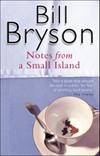
Bill Bryson's Notes from a Small Island

American Bill Bryson penned his Notes from a Small Island after living and working in the UK for twenty years. It is supposed to be a travelogue as seen through the eyes of a foreigner. The problem is that after two decades he is not sure whether he is a Yank or a Brit, and he just comes across as a jerk.  Notes compares Bryson's memories from when he arrived in 1973 with his experiences during a 'valedictory tour' after he decides to return stateside in 1993.

He pines for the England he remembers from his early days, but he recalls a Britain that never actually existed.  It becomes clear that he is missing the cosy image of the UK as featured in 1970s television. It was not there in 1973, and still not there in1993.  He is angry that he cannot find what he is looking for.   He is actually angry about a lot of things: dogs (he wants to kick small ones and beat big ones with a stick); fat people (because they get to the dessert trolley before him); and Rupert Murdoch's takeover of the Times. (OK with hindsight he might have been right about that one.)

Bryson would be a most objectionable travel companion: glaring at anyone he deems less than perfect; ranting whenever he fails to get his own way; penny pinching on food and accommodation, then surprised at the poor standard he receives.

He spends a great deal of the book complaining, or damning with faint praise.  In spite of his regular assurances that he loves the country and will miss it when he leaves, he seems not actually to like a single thing in it. In fact at one point he devotes a whole page to listing things he dislikes about Britain, including Oxford. Within a very short time it becomes clear that he is a rude, self centred, overbearing, bad tempered tightwad.  

Perhaps he is trying to be funny, and there are moments in the book that made me laugh out loud, but even after twenty years, in common with many Americans, he fails to understand irony, and when he attempts it he just ends up being cruel.

Monday, August 15, 2011

A weekend read

I finished reading Arnaldur Indriưason's Tainted Blood  this weekend. If you want to know what I thought, checkout the Just Read page.

Tuesday, April 26, 2011

Review: Theme for a Summer by Sandra Davies

Theme for a Summer by Sandra Davies is a story of a time long gone, but handles questions that are still relevant fifty years on.

The book explores the changing moral standards of the 1960s through the eyes of a group of teenage girls. They are all reaching an age where they must choose where they stand on the question of sexual mores.

When their comfortable associations with, and long-term crushes on, the local lads are disturbed by the arrival of a clan of Irish brothers, they are soon embroiled in the consequences of their choices.

The story starts innocently enough with a little under-age drinking. A smoothly operated cover-up, launched by the single word 'plod', expels the girls onto the village streets. Here we learn of the challenge that the group have set themselves for the coming school holiday. They must all try to 'get off with' as many of the boys as they can before September arrives and ends the summer break.

Central to the plot is the relationship between Bridie Burdock and Sean Donovan, but there are many other associations within the potentially disastrous realms of the summer challenge.

To be fair, there are so many characters involved in the story that the names are a little confusing at first and it takes a few chapters to get the hang of everyone's familial relationships. But persevere.

Along the way there is plenty of opportunity to observe the effects of the emergence of the hippy generation on small town life. We also discover that the idea of 'free love' was not all that new, and that it was never truly free of all costs. We also encounter the double standards that parents can operate in rules for their children.

Theme for a Summer is nicely evocative of the time and regular mention of the hits of the era helps to recreate a vivid picture for anyone who lived through those years.

The plot appears predictable at first but takes some sharp turns away from the expected direction. At the end the reader is left wanting to know more, which is a good thing for the first in a series of books that follow Bridie and Sean's progress across a couple of decades.

The book is available by clicking the link at Sandra's blog Lines of Communication.  She completed another section of the tale for National Novel Writing Month (NaNoWriMo) last year and is currently working on the latest volume of the tale.

A printmaker, Sandra also designed the covers for all the Bridie books.

UPDATE from Sandra. June 2012:  Can I please update this by saying that 'Theme for a summer' is now available from Lulu, in a combined volume with Book 2, 'Reunion'. Also the two that follow that, 'Holding steady' (my first NaNoWriMo novel) and 'Damage limitation' in print and as ebooks.


http://www.lulu.com/shop/sandra-davies/theme-for-a-summer-and-reunion/paperback/product-20189895.html

Thursday, March 10, 2011

The Great Transworld Crime Caper 3: The Business of Dying by Simon Kernick


I've been very lucky to have been accepted to take part in the Great Transworld Crime Caper and that gave me the chance to read and review three novels from their catalogue.  This is number three.  If you'd like to read the other reviews too, they are linked at the bottom of the page.


A writer friend once told me that all the best stories start with a great "what if?" and that might explain what makes The Business of Dying such a riveting read. It begins with one of the best "what if?" assumptions I have ever encountered. What if a mid ranking police officer became so disillusioned with his job that he decided to moonlight as a professional hitman? It's a thrilling place to start a book because within a few pages three men have been murdered in a gangland style killing and the reader does not discover that the gunman is actually Detective Sergeant Dennis Milne until a roadblock forces him to use his warrant card to escape. (Unless you read the jacket blurb, of course.)

It soon becomes obvious that he has been set up, however, when news reports reveal that the dead men were customs officers, rather than the drug dealers he thought he had assassinated. In spite of his part-time occupation Milne is not a bad man. He joined the force to help remove some baddies from the world. He began executing them only after it became clear that modern policing was unlikely to have any long term effect on crime rates or to apprehend the real offenders. There is some interesting and thought provoking discussion on how he justifies his double life and readers are left wondering whether, in the same circumstances, they might not be driven to doing the same thing.

Given that Milne is a senior detective it is no surprise that bodies arrive thick and fast in this tale, and not all as a result of his handiwork. There is enough police procedure to satisfy the amateur sleuths who want to work out for themselves whodunnit but this is not a polished forensic drama. It has none of the glib crime-fighting paraphernalia that has taken over a lot of detective fiction since the advent of CSI.  Neither are the murders quite as straightforward as many writers would have us believe. Guns jam. Victims fight back. Blood squelches. Corpses make revolting noises. The business of dying is truly messy.

The book is Simon Kernick's first, and is a much better novel than an author's debut outing usually achieves. It has been re-released on the strength of his later success with Relentless, but this one deserves to be widely read too. Milne comes across as a real guy, facing real dilemmas in a very real world. He is also lacking in many of the now clichĆ©d world-weary copper attributes that have littered crime novels for the last decade. For example, he drinks because he enjoys it, or because he has had a bad day at work, or because he has just killed someone. We imagine we would have a glass or two for the same reasons. His habit is not a plot device, it is a genuine part of the character.   OK, so his love life is not too promising, but police work is often cited as having a high divorce rate so that is also believable. (It does mean that he is free to sleep with a suspect, however, even after she makes some startling and incriminating admissions, which is a little far-fetched.)
Beyond that there is little to detract from this cracking tale with its unusual premise. It spins along at a swift pace and is far from predictable along its route. Read it soon. Because life’s too short.


The other two reviews were:

Robert Goddard
Past Caring


Simon Beckett
The Chemistry of Death